Digital film-out negatives and prints(c.1976–Present)
The process of recording digital visual content onto motion picture negative or print stock.
Film Explorer
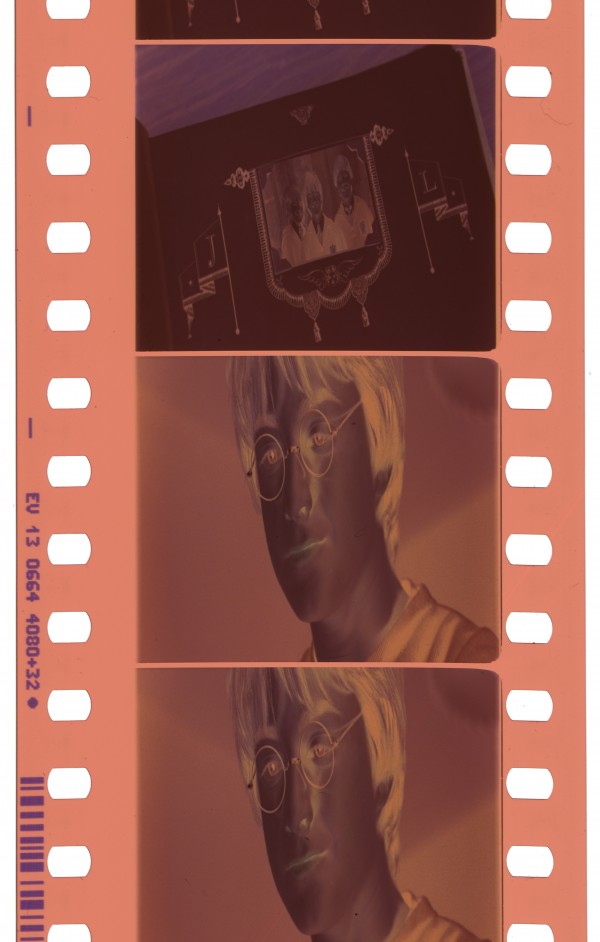
A 35mm film-out negative of Harry Potter and the Chamber of Secrets (2002), recorded at 2K resolution.
The Museum of Modern Art, New York, NY, United States.
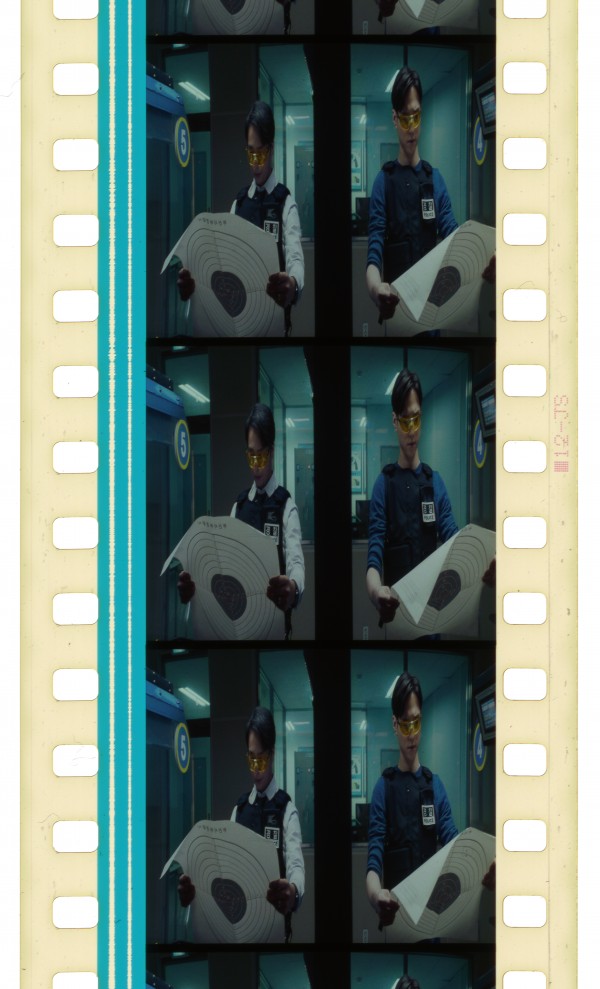
A 35mm film-out print of Park Chan-wook’s Decision to Leave (2022). This particular print was made at CPC London in a Cinevator film recorder directly from master digital files. There was no negative. This workflow is often referred to as “direct-to-print”.
Identification
(35mm)
Color or B/W.
Standard Eastman Kodak or Fuji edge markings.
All film-out negatives are typically mute. Direct-to-print copies often feature a cyan dye track, recorded simultaneously with the image, but lack the full audio resolution of a printed optical track.
4-perforation, vertical (35mm); 8-perforation, horizontal (VistaVision); 5-perforation, vertical (65mm); 8-perforation, vertical (65mm); 15-perforation, horizontal (65mm).
Color or B/W intermediate stock. Sometimes camera negative.
Standard Eastman Kodak or Fuji edge markings.
History
The film-out process began in earnest in the 1980s as a means for transferring computer-generated visual effects (VFX) and commercials onto 35mm negative film. Later, from the late 1990s onwards, as digital scanners and film recording technology advanced, entire feature films were edited and graded in digital form and then recorded back to film for making theatrical release prints. That process became known as the Digital Intermediate (DI). Following the demise of widespread film distribution in favor of Digital Cinema Packages (DCPs) in the 2010s, direct film-outs to negative or print have become scarcer, although the practice continues for high-profile festival screenings, boutique theatrical events and film preservation.
Prior to the development of digital film-out technologies, videotape-to-film transfers were not uncommon. These were often accomplished by filming a video signal directly from a high-resolution CRT-type monitor. From the 1960s into the early 1980s, Technicolor operated a subsidiary known as Vidtronics that could transfer video footage to film. A notable example in this area came with the nascent film-out work on Monty Python Live at the Hollywood Bowl (1982) that was photographed natively on videotape. Through the efforts of Image Transform in Universal City, California, the production was filmed-out in its entirety on 16mm B/W negative using the successive exposure technique (red, green and blue frames captured one after the other on a single strip of film), before being recombined on 16mm color print film for theatrical release in select markets. The work performed by Image Transform included frame-rate conversions from video to film.
Early examples of film-outs of computer-generated imagery include select shots in Futureworld (1976) and Star Trek II: The Wrath of Khan (1982), and a substantial portion of Walt Disney Productions’ Tron (1982), directed by Steven Lisberger (Rodríguez, 2025). Another early example of a digitally rendered sequence appeared in director Barry Levinson’s 1985 live-action feature, Young Sherlock Holmes – with VFX produced by Industrial Light & Magic (ILM). As computational power increased over the decade, matched by a maturing visual effects industry, arguably the most stunning example of early digitally-created imagery for a theatrical feature was the hydro-pod sequence of director James Cameron’s Academy Award-winner for VFX, The Abyss (1989) – the sequence was also created and filmed-out by ILM, under the supervision of Oscar recipient John Bruno. Around this time, ILM collaborated with Eastman Kodak on a prototype film scanner (Joshua Pines, pers. comm., Sept. 2026).
A number of animated short films produced in the mid-1980s were filmed-out in their entirety and first publicly presented at the Siggraph Electronic Theatre – a computer animation film festival. One very striking milestone was Pixar’s Luxo Jr. (1986), created by director John Lasseter and producer William Reeves, and filmed out to 16mm color negative. To accomplish Pixar’s achievement, the company created a proprietary film-recording system in collaboration with Agfa. Beginning with The Rescuers Down Under (1990), and lasting until the early 2000s, all major Disney feature animation releases were completed using the studio’s Computer Animation Production System (CAPS), which included digitally applying the colors to hand-drawn animation and recording to 35mm B/W successive exposure negative using a CELCO Film Recorder.
In 1992, Eastman Kodak formally launched its groundbreaking Cineon System (first developed with ILM in the 1980s), an integrated suite of hardware and software, consisting of the first high-resolution digital file format designed for moving images – known as Cineon (.cin) – along with the Cineon Film Scanner and Cineon Lightning Laser Film Recorder. This system was a conscious attempt to improve upon and replace Kodak’s Color Reversal Intermediate (CRI) printing film with a digital equivalent that avoided generational loss of image quality through multiple steps of printing. This was initially named Color Digital Intermediate (CDI) and later shortened to Digital Intermediate (DI). The first installation of this Cineon equipment was at Cinesite (a subsidiary of Kodak) in Burbank, California. It was capable of capturing and recording a Super 35 frame at a maximum resolution of 4K (4096 x 3112 pixels), at a rate of three seconds per frame (Eastman Kodak, 1991). The first motion picture scanned and recorded back to film in its entirety was Disney’s 1993 restoration of Snow White and the Seven Dwarfs (1937).
The introduction of the Cineon file format is considered a watershed moment in the evolution of and transition to digital. Companies like ILM created departments within their VFX pipeline dedicated to scanning and recording – known as Scan-Record. The game changed for the motion picture industry when VFX vendors could produce results of such fidelity that their work became seemingly invisible. The best examples of this are found in two projects handled (in part) by ILM, Terminator 2: Judgment Day (1991) and Jurassic Park (1993), mastering VFX shots and recording these out to 35mm film at approximately 1.7K resolution (Joshua Pines, pers. comm., Sept. 2026). Industry color scientist Joshua Pines noted that the scanning of imagery for digital manipulation and the filming-out back to motion picture negative stock were essentially two sides of the same coin. Pines further noted that once the digital genie was out of the bottle, the post-production and VFX industries had to up their game considerably to accomplish a seamless transition to digital (Joshua Pines, pers. comm., Dec. 2024).
In the mid-to-late 1990s, Søren Kloch at Herremagasinet Film & TV (and subsequently at Hokus Bogus) in Copenhagen, Denmark, developed a makeshift film-out-to-35mm workflow using an Agfa Alto Film Recorder, originally intended for making 35mm stills and slides. This advance was spurred by the Dogme 95 movement, launched by Danish filmmakers Lars von Trier and Thomas Vinterberg, whose films – like Festen (The Celebration, 1998) and Idioterne (The Idiots, 1998) – were shot on standard definition digital video but exhibited on 35mm prints. “It was a slow and laborious process,” recalled Kloch, “stressing the equipment [...] and the operators to exhaustion.” In recording to 35mm Eastman Color negative, each frame took between 45 and 90 seconds to record. “We literally slept next to the computers making sure the process was running smoothly – and offloading and loading [...] vast amounts of image data into the system” (Søren Kloch, pers. comm., Jun. 5, 2026).
A watershed moment came in 2000 with the Coen brothers’ O Brother, Where Art Thou? – recognized today as the first feature to go through a full digital intermediate. This work was completed at Cinesite in Burbank and was the first real demonstration of DI’s future capabilities. The following year, Technicolor launched Technique, its first incarnation of digital intermediate post-production, enabling, among other productions, the digital post-production and grading of the stylistically eclectic Panic Room (2002), the Kill Bill films (2003/2004) and The Aviator (2004), achieving aesthetics that were not possible using traditional photochemical means. At the same time, EFilm began its DI service to the industry on films such as We Were Soldiers (2002), for Paramount Pictures, and Frida (2002), directed by Julie Taymor. The first European feature scanned, digitally graded and output back to film in its entirety was Aardman Animation’s Chicken Run (2000), using Computer Film Company (CFC) in London, while Laboratoires Éclair in Paris was another early adopter in Europe, completing the digital post-production of Jean-Pierre Jeunet’s Amélie in 2001. In Australia, Atlab was a pioneer in digital services, beginning in the 1990s.
The last incarnations of the Harry Potter franchise in 2010/11 witnessed the production of over 20,000 theatrical international release prints – to go out “day and date” – manufactured by Technicolor from its release printing operations in Los Angeles, Montreal, London, Bangkok and Rome. Twenty 2K 35mm printing negatives were filmed-out by Technicolor on its Cinevator recorders – for prints made exclusively for theatrical release, with one 4K 35mm film-out negative created on an ARRILASER to create prints for prestige presentations.
As the digital revolution consolidated, by 2012 the entire release printing pipeline at Technicolor (and later at Deluxe) was wound down in favor of the new industry DCP standard for digital projection – as such, the need for 35mm film-out negatives decreased dramatically and eventually ceased almost outright. As a result, making 35mm film prints has become a boutique service – outside of the ambitious recent works by Christopher Nolan and Paul Thomas Anderson – limited mostly to single “direct-to-print” copies made directly from digital files for festival screenings and single theater engagements.
Today (circa 2026), film-recording is also found in various restoration processes including the recombination of digital YCM masters (printed on 35mm film) for quality control purposes – the process being commissioned by studio management to archivally protect and preserve newly produced and selectively designated assets. Similarly, new restoration master elements will selectively be shot to celluloid for preservation purposes.
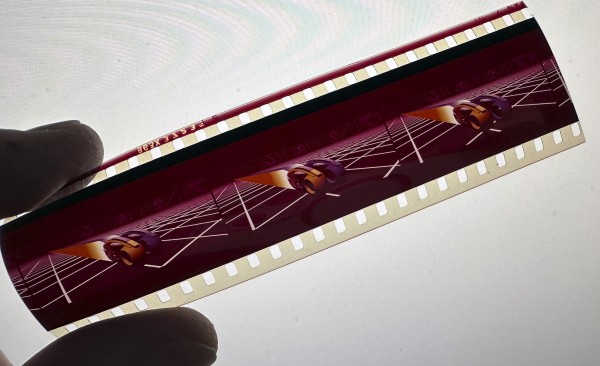
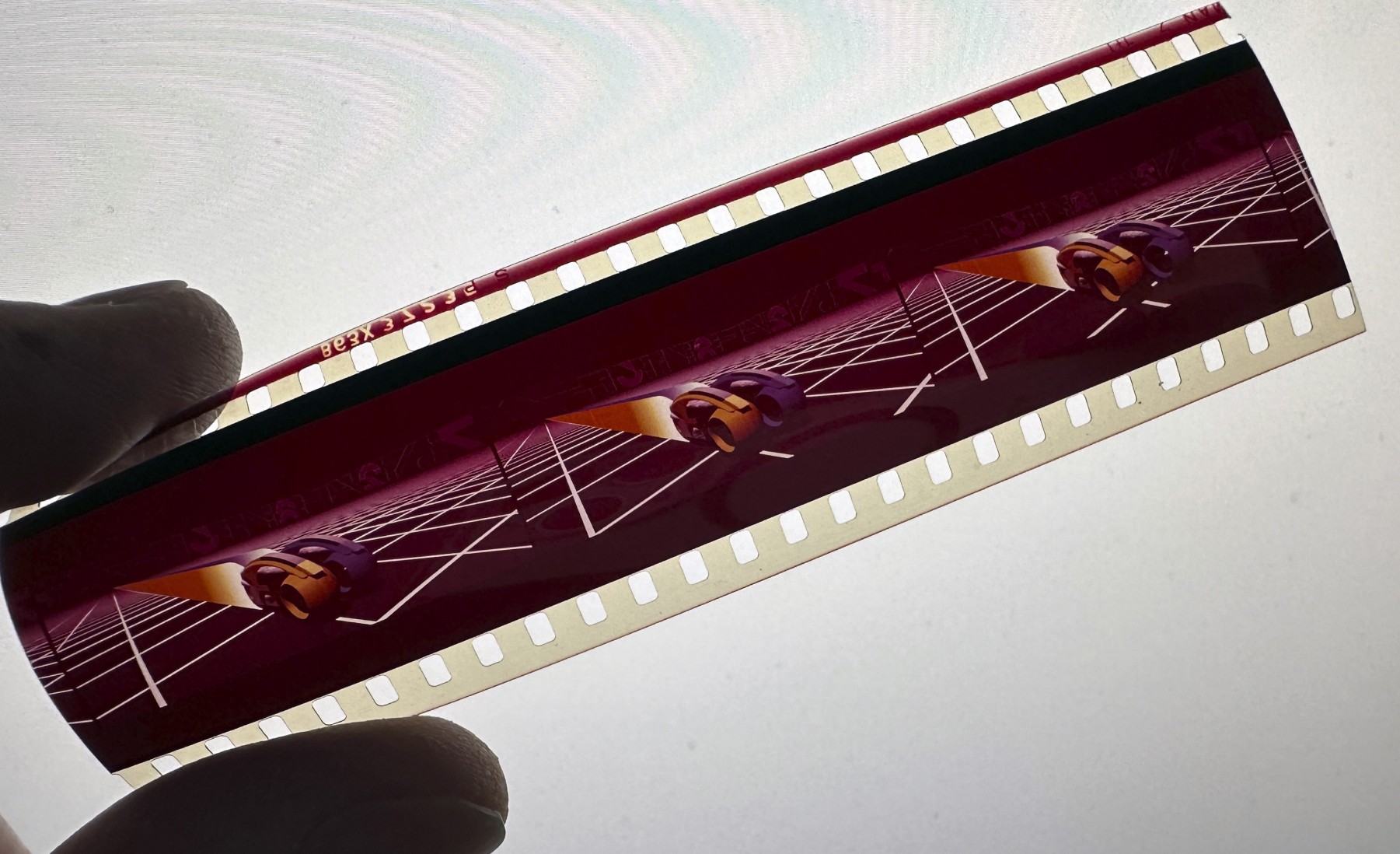
A clipping from 35mm VistaVision dailies for Tron (1982), contact printed from a 35mm VistaVision film-out negative made by MAGi on a CELCO Film Recorder.
Courtesy of Rob Hummel.
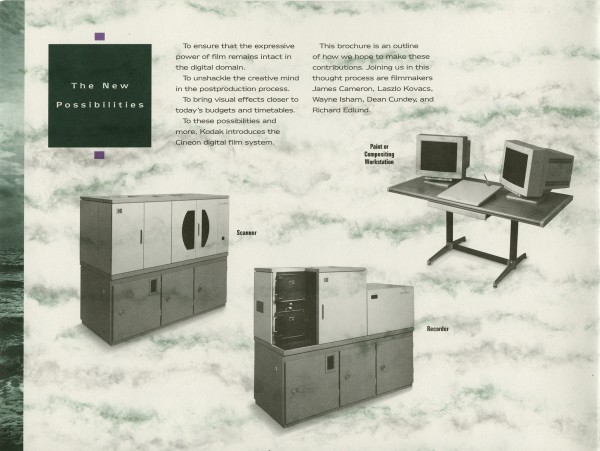
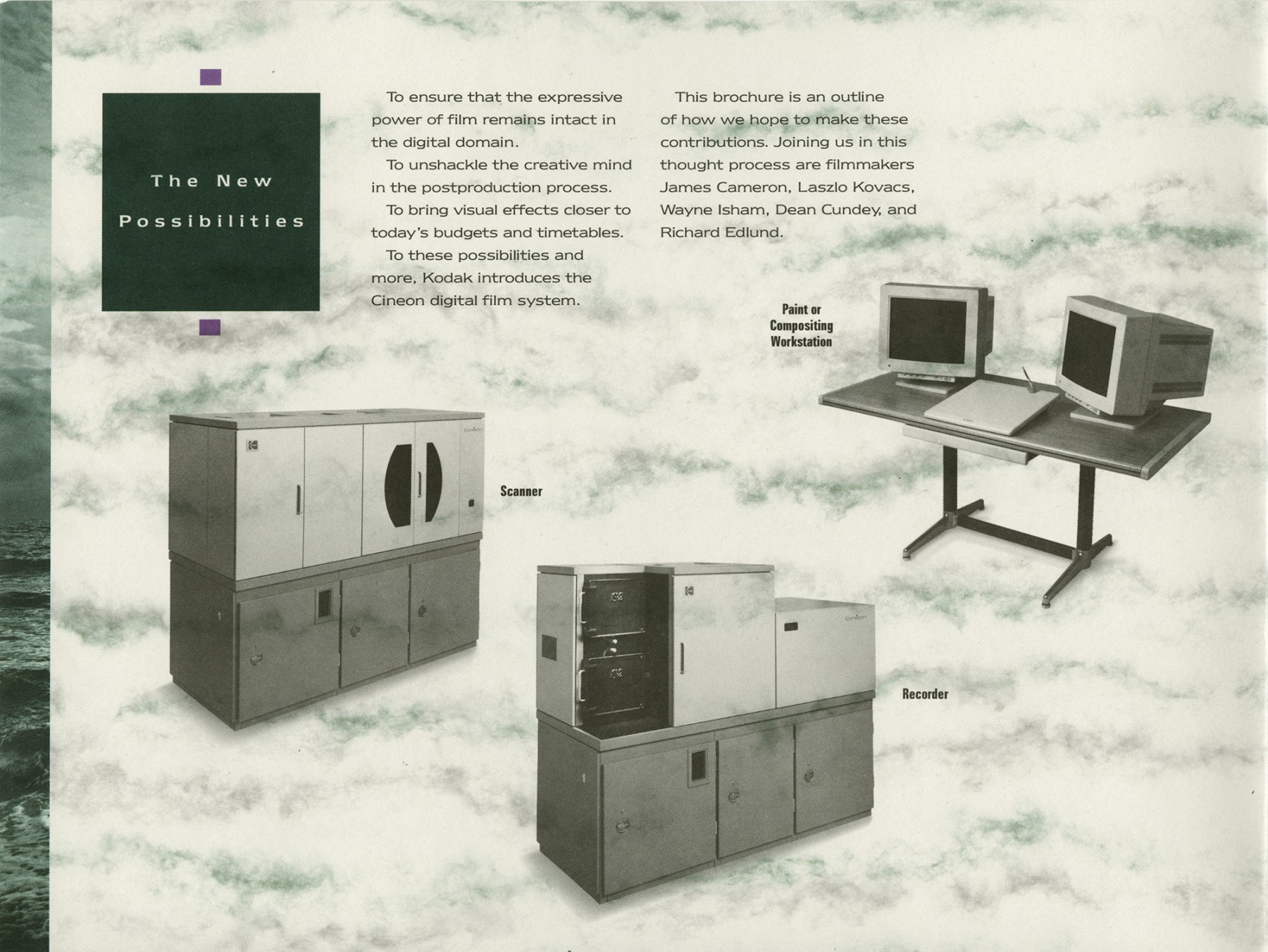
Eastman Kodak’s pioneering Cineon System incorporated a scanner, workstation and film recorder. Cineon Digital Film System promotional brochure, c. 1992.
Richard Goldberg Collection, George Eastman Museum, Rochester, NY, United States.
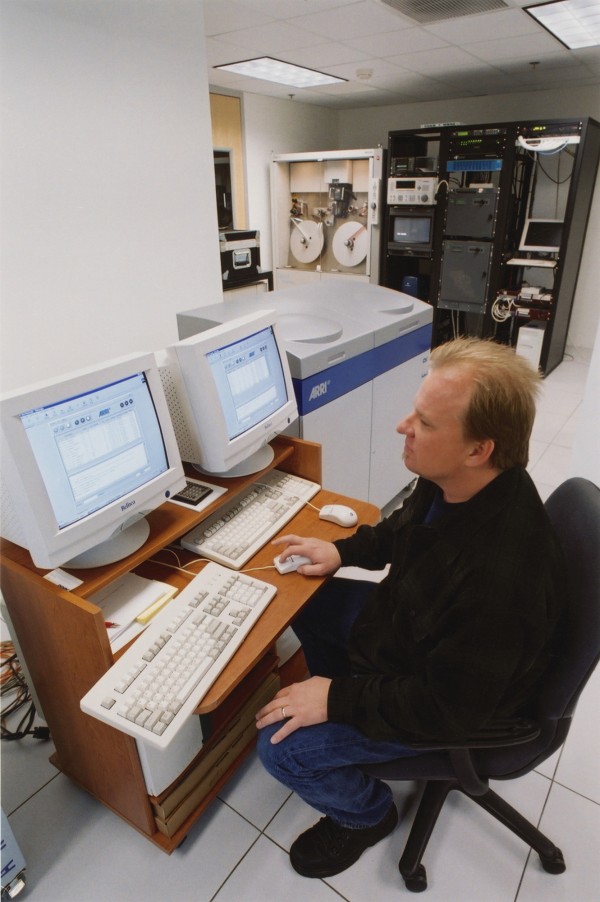
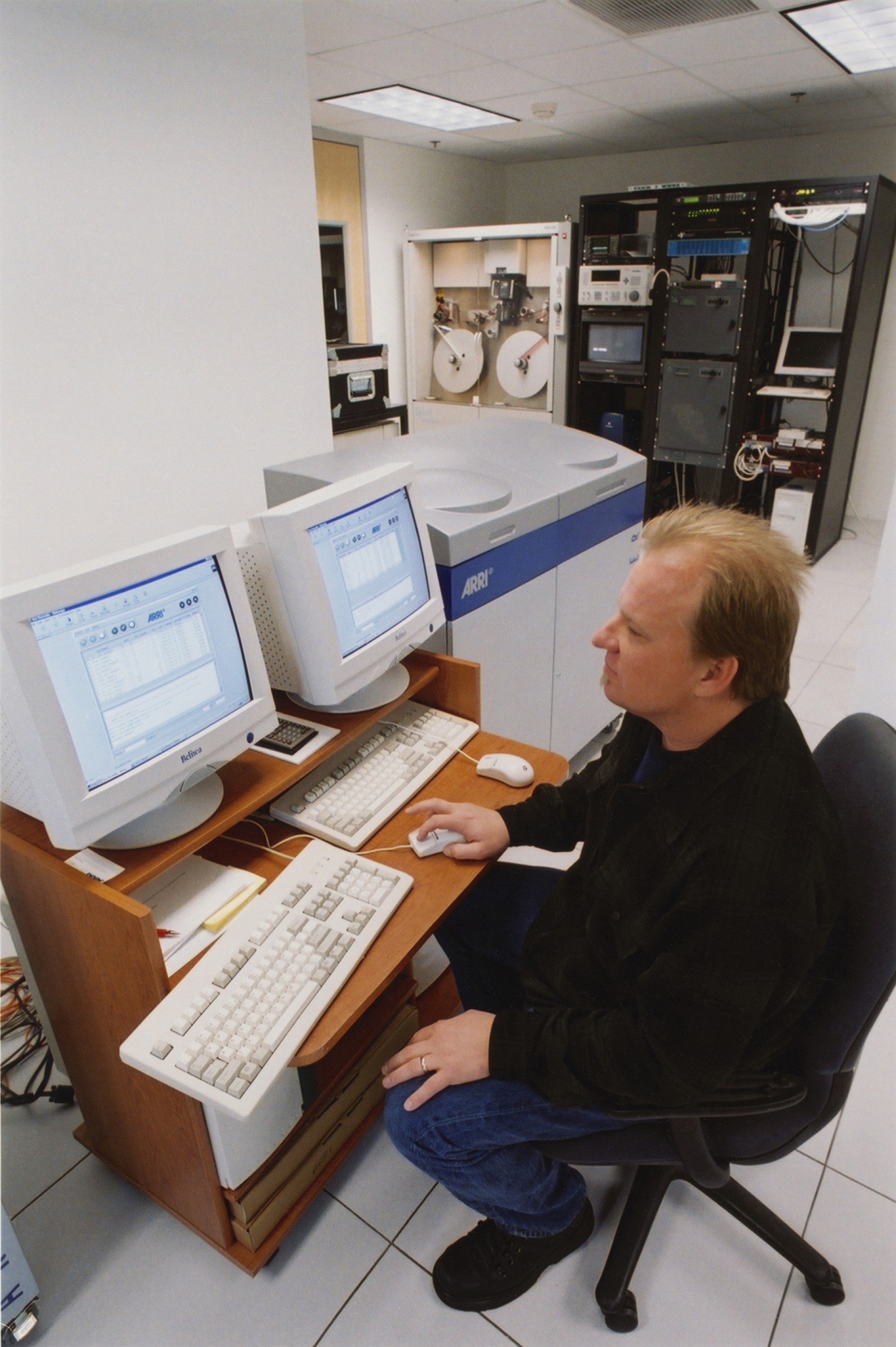
Steve Hodge sits at the ARRILASER workstation, completing a film-out from master digital file to 35mm negative. In 2001, Technicolor formed a new digital division called Technique, located in Burbank, California, to service the film industry’s digital post-production needs.
Technicolor Corporate Archive, George Eastman Museum, Rochester, NY, United States. Photograph by Anthony Friedkin.
Selected Filmography
The first feature film to undergo a full digital intermediate workflow. Scanned at 2K resolution using a Spirit Datacine, digitally graded on computers and filmed-out using a Cineon Lightning II Laser Film Recorder by Cinesite in Burbank, CA.
The first feature film to undergo a full digital intermediate workflow. Scanned at 2K resolution using a Spirit Datacine, digitally graded on computers and filmed-out using a Cineon Lightning II Laser Film Recorder by Cinesite in Burbank, CA.
The first European production with a full digital intermediate. Work completed by The Computer Film Company (CFC) in London.
The first European production with a full digital intermediate. Work completed by The Computer Film Company (CFC) in London.
Shot on standard definition MiniDV videotape, Festen was recorded to 35mm film by Hokus Bogus in Copenhagen using an Agfa Alto Film Recorder.
Shot on standard definition MiniDV videotape, Festen was recorded to 35mm film by Hokus Bogus in Copenhagen using an Agfa Alto Film Recorder.
The first Harry Potter film to go through a full digital intermediate. Scanning and film recording were completed by Cinesite in London, with digital grading overseen by Peter Doyle at Warner Bros. The film is notable for its gritty, desaturated look – a stark departure from the brighter, more colorful aesthetic of the first two films in the series. Prints manufactured by Technicolor.
The first Harry Potter film to go through a full digital intermediate. Scanning and film recording were completed by Cinesite in London, with digital grading overseen by Peter Doyle at Warner Bros. The film is notable for its gritty, desaturated look – a stark departure from the brighter, more colorful aesthetic of the first two films in the series. Prints manufactured by Technicolor.
Although distributed exclusively in digital around the world, at least one 35mm print was made by CPC London using a Cinevator film recorder as a “direct-to-print” copy. This print was subsequently donated to the Museum of Modern Art, New York.
Although distributed exclusively in digital around the world, at least one 35mm print was made by CPC London using a Cinevator film recorder as a “direct-to-print” copy. This print was subsequently donated to the Museum of Modern Art, New York.
The first feature entirely filmed-out from digital files to 35mm negative. Work was completed in-house by Disney and overseen by Joe Jiuliano, using a CELCO Film Recorder.
The first feature entirely filmed-out from digital files to 35mm negative. Work was completed in-house by Disney and overseen by Joe Jiuliano, using a CELCO Film Recorder.
Disney’s 1993 restoration was the first feature film to be scanned and recorded back to film in its entirety. Work was completed by Cinesite in Burbank, CA, using Eastman Kodak’s Cineon suite of hardware and software.
Disney’s 1993 restoration was the first feature film to be scanned and recorded back to film in its entirety. Work was completed by Cinesite in Burbank, CA, using Eastman Kodak’s Cineon suite of hardware and software.
A milestone for CGI visual effects. After rendering the VFX, Industrial Light & Magic used a Solitaire Image Recorder to create a 35mm negative. The negative of these VFX shots was then directly spliced into the original camera negative.
A milestone for CGI visual effects. After rendering the VFX, Industrial Light & Magic used a Solitaire Image Recorder to create a 35mm negative. The negative of these VFX shots was then directly spliced into the original camera negative.
The film’s groundbreaking computer-generated visual effects were created by multiple vendors and were recorded out to horizontal VistaVision negative. Triple-I had to adapt its custom film recorder to handle VistaVision film; MAGi first recorded its effects to magnetic tape and then transferred to film using a CELCO Film Recorder; while Digital Effects achieved its best results with a Dicomed D-48 film recorder (Rodríguez, 2025).
The film’s groundbreaking computer-generated visual effects were created by multiple vendors and were recorded out to horizontal VistaVision negative. Triple-I had to adapt its custom film recorder to handle VistaVision film; MAGi first recorded its effects to magnetic tape and then transferred to film using a CELCO Film Recorder; while Digital Effects achieved its best results with a Dicomed D-48 film recorder (Rodríguez, 2025).
Digital Domain’s first major feature.
Digital Domain’s first major feature.
Although most of Christopher Doyle’s stunning cinematography was accomplished photochemically, one sequence featuring vivid green drapes required digital color correction to obtain the bold color desired by the filmmakers. Work completed by Atlab in Sydney, Australia.
Although most of Christopher Doyle’s stunning cinematography was accomplished photochemically, one sequence featuring vivid green drapes required digital color correction to obtain the bold color desired by the filmmakers. Work completed by Atlab in Sydney, Australia.
Lineage
Technology
Recording digital moving images to a film negative was only one step in a standard visual effects (VFX) or Digital Intermediate (DI) workflow. Such workflows typically began with scanning the source material at high resolution (most commonly 2K or 4K), then augmenting the imagery with digital effects or color-correcting the film, before a film-out negative was created using a film recorder. This negative was subsequently processed by a film laboratory. Such negatives could then be physically cut into the original camera negative (in the case of VFX shots) or could be used as printing negatives (internegatives) for making release prints. Many film recorders were designed to be compatible with multiple film formats, including 4-perforation 35mm, 8-perforation VistaVision, 5-perforation 65mm, 8-perforation 65mm and 15-perforation IMAX.
The film-out process grew out of, and to some extent in parallel with, methods first employed for television as well as commercial advertising production, with a process also known as film-recording. Some of the technology used was initially developed for the slide production industry (mass producing slides from digital still images) and subsequently refined for motion picture use.
There have been two main types of film recorders for motion picture film: CRT and Laser. CRT recorders used a magnetically deflected beam hitting a phosphor cathode ray tube screen, and often required separate exposures of red, green and blue frames on B/W negative. These machines initially took minutes to expose each frame due to the limited phosphor brightness of the CRT screen (although film-out timings improved significantly over the years). Laser recorders used either gas (Cineon Lightning) or solid-state (ARRILASER) laser beams to expose pixels on the film line by line, delivering higher speeds (~2–4 seconds per frame) and deeper dynamic range (ARRILASER Technology versus CRT Technology, n.d.).
The following list provides an overview of some of the most popular models of film recorders.
CELCO Film Recorder: A CRT-based film recorder first used for motion picture work on Tron (1982) and subsequently used extensively by Walt Disney Animation Studios from c. 1989 onwards in conjunction with its Computer Animation Production System (CAPS).
Solitaire Cine Image Recorder: A CRT-based recorder introduced by Management Graphics Inc. in 1990. Notably used for film-outs of the VFX sequences on Terminator 2: Judgment Day (1991), Jurassic Park (1993), Forrest Gump (1994) and the entire film-out of Toy Story (1995). Compatible with 35mm and 65mm negative (including IMAX).
Cineon Lightning Laser Film Recorder: The first laser-based film recorder, developed by Eastman Kodak and launched in 1992. Used on the pioneering 1993 digital restoration of Snow White and the Seven Dwarfs (1937), and for filming-out the digital effects in numerous effects-heavy movies during the 1990s, including Super Mario Bros. (1993), Space Jam (1996) and Pleasantville (1998). Replaced by the Lightning II recorder around 1997.
ARRILASER: A laser-based film recorder developed by Arnold & Richter Cinetechnik (Arri) in Germany. Prototypes of the first ARRILASER Recorder were tested in 1998 at visual effects houses Digital Domain in the US and The Computer Film Company (CFC) in London. It was later chosen as the replacement for the original Cineon Lightning Laser Film Recorders at Cinesite in London. DuArt Laboratories in New York City was an early adopter in the United States.
Cinevator: A DLP-based film recorder developed by Cinevation AS in Norway. Instead of lasers, the Cinevator used LED-illuminated Digital Light Processing (DLP) chips to project and write entire frames onto film in real time. It was capped at a maximum resolution of 2K and, as such, was usually confined to making release printing negatives or “direct-to-print” copies rather than master negative elements. The first Cinevator recorders were purchased in 2007 by Nordisk Film in Norway and Technicolor in the US.
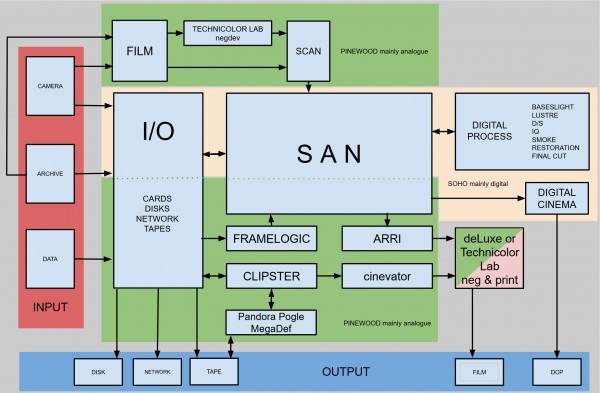
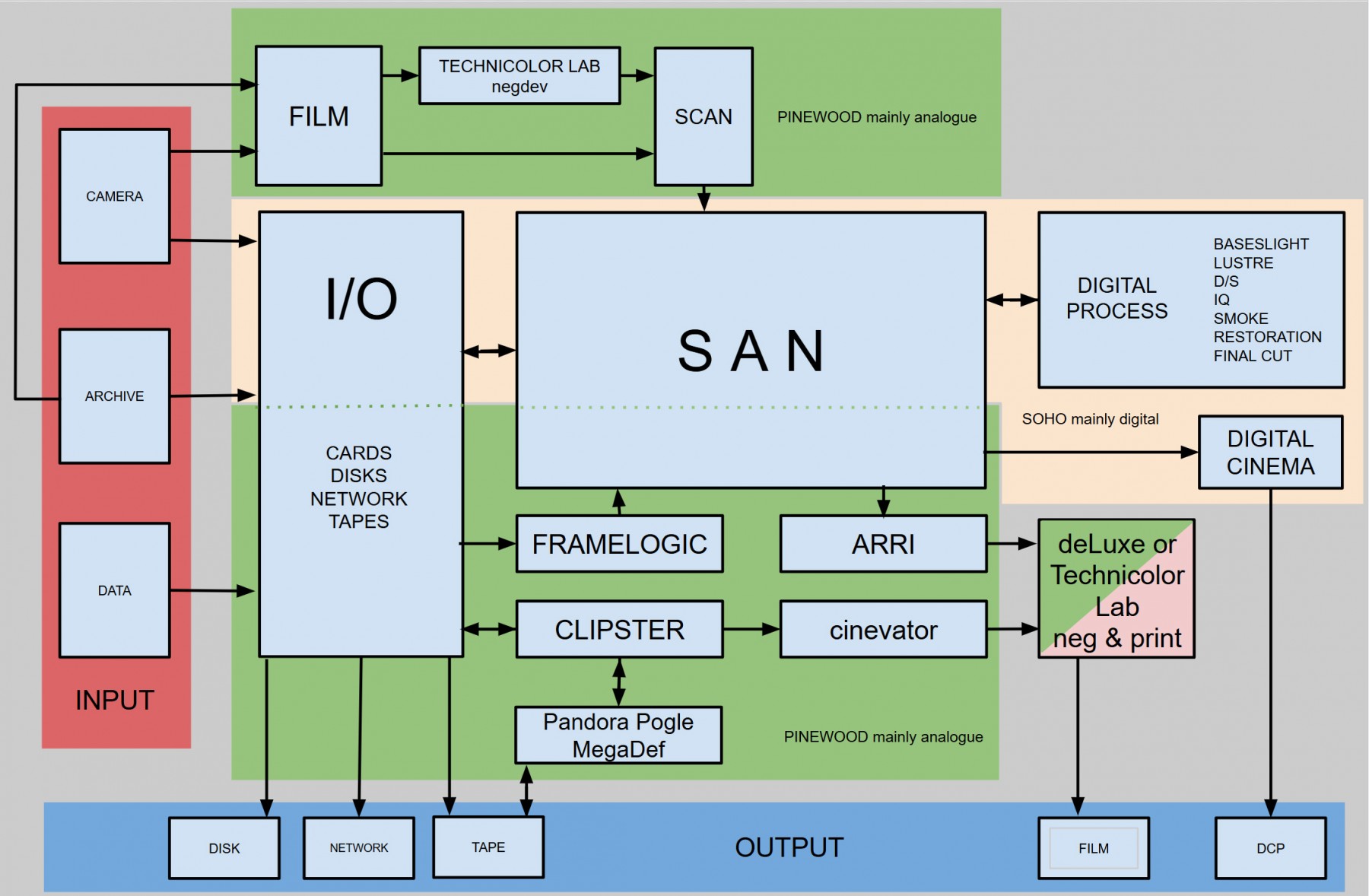
Generic film scanning and recording workflow for Technicolor London, c. 2012. The exposed source film is received, developed and scanned at Technicolor’s Pinewood facility in the top green box before being worked on digitally at Technicolor’s Soho facility in the pale yellow box. From here, digital (DCP) and film deliverables were made. The film-out negatives for archiving and release printing were created on ARRILASER and Cinevator film recorders.
Courtesy of Mitch Mitchell.
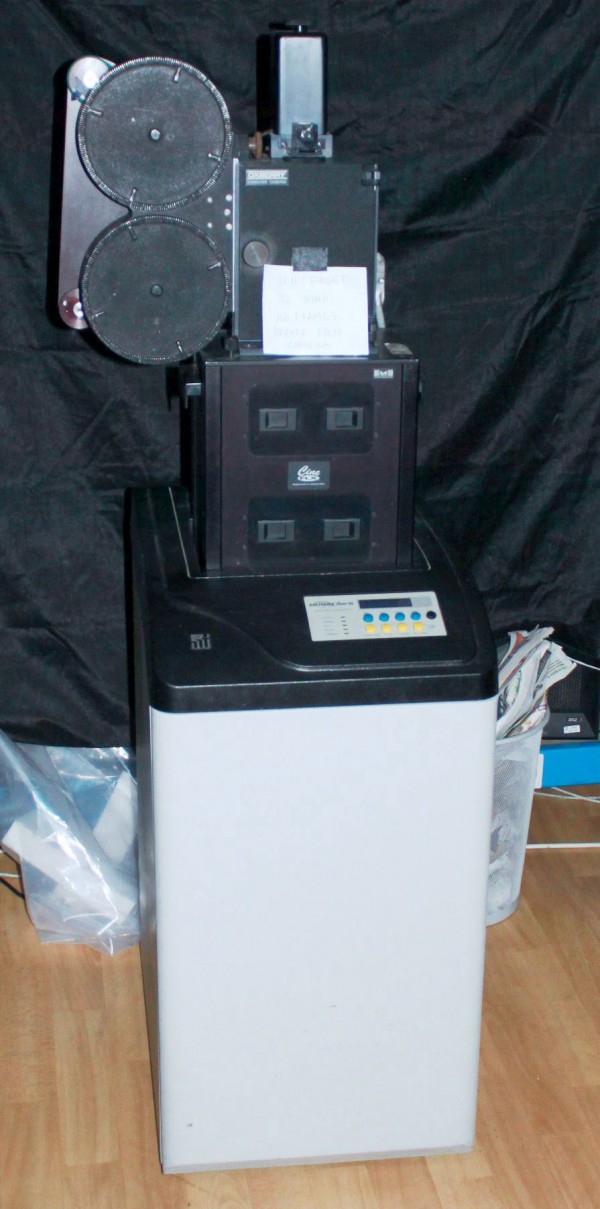
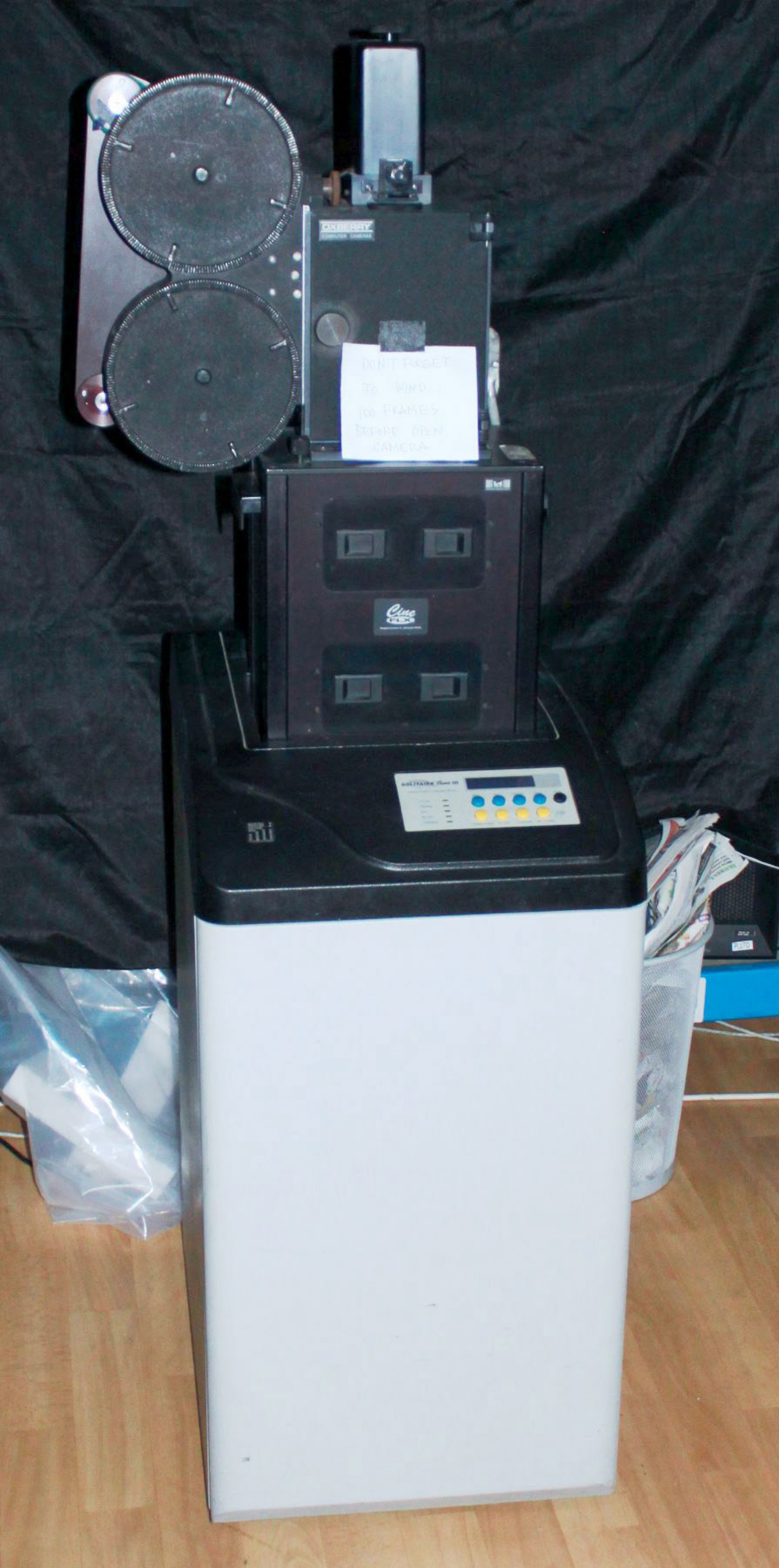
A Management Graphics Inc. Solitaire Cine III Film Recorder (bottom) mounted with an Oxberry 3100 camera (top). This film recorder was introduced in 1996 and was fully integrated with Kodak’s Cineon software.
a406.com (n.d.). “For Immediate Disposal Offers Invited: For Sale Film Restoration Equipment, London N7”. (website) http://www.a406.com/Film (accessed Aug. 29, 2026).
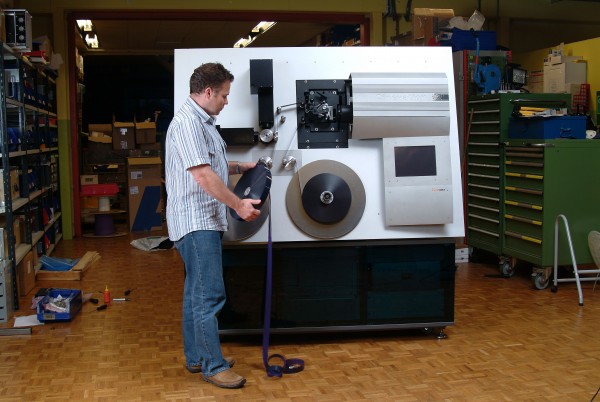
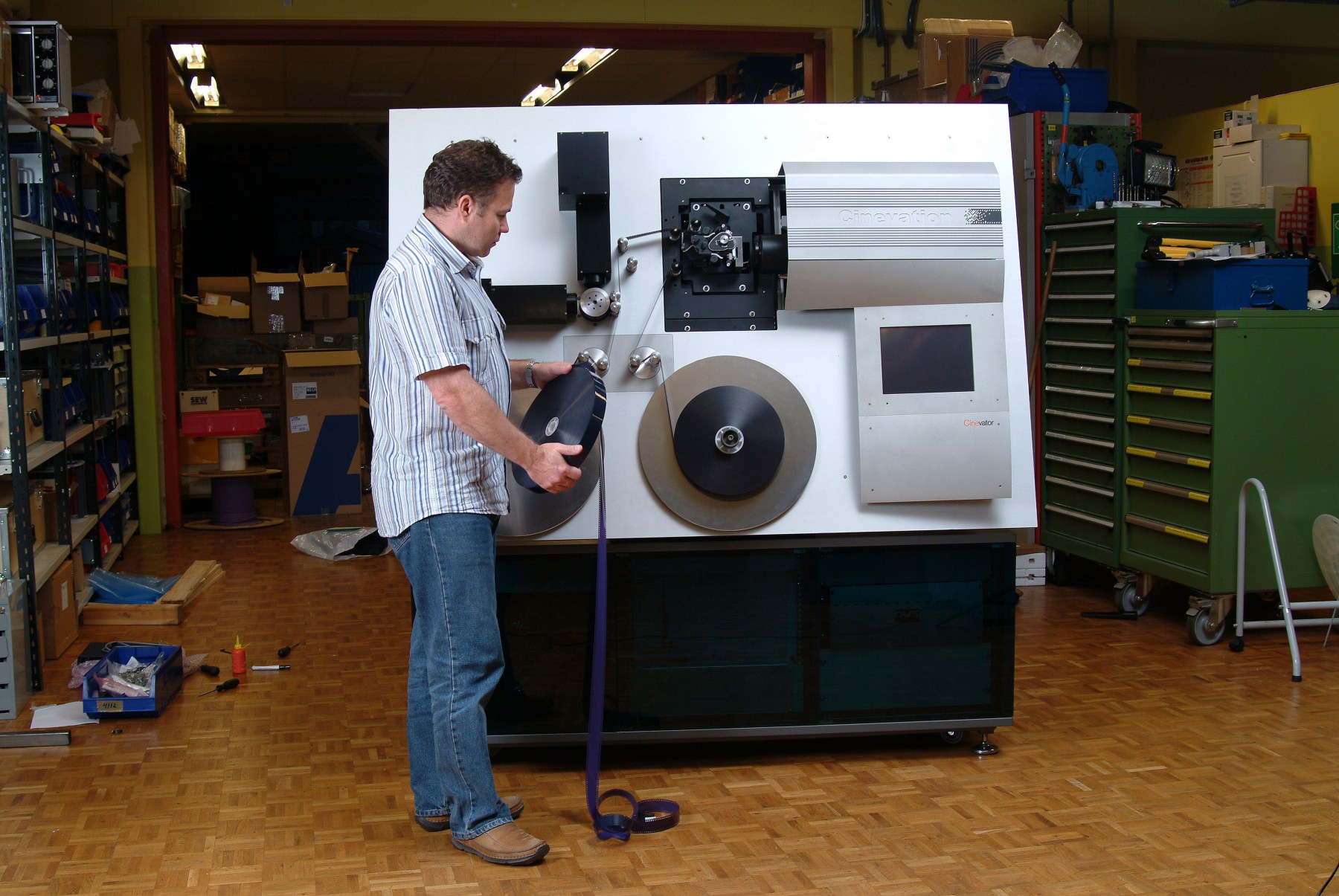
The Cinevator 35mm film recorder, made by the Norwegian company Piql. When it was announced at a trade show in 2004, the Cinevator was claimed to be 100 times faster than other film recorders on the market.
Piql, Drammen, Norway. https://piql.com/technology/cinevator (accessed Aug. 27, 2026).
References
Arri Group (n.d.). “ARRILASER Technology versus CRT Technology” (white paper) https://www.scribd.com/document/464092728/ARRI-laser-Technology (accessed Aug. 25, 2026).
Belton, John (2008). “Painting by the Numbers: The Digital Intermediate”, Film Quarterly, 61:3 (Spring): pp. 58–65.
Eastman Kodak (1991). Kodak High Resolution Electronic Intermediate System (Apr.). Technicolor Corporate Archive, George Eastman Museum, Rochester, NY, United States.
Eastman Kodak (c. 1992). Cineon Digital Film System. Technicolor Corporate Archive, George Eastman Museum, Rochester, NY, United States.
FIAF (n.d.). “Glossary of Technical Terms”. FIAF (website). https://www.fiafnet.org/pages/E-Resources/Technical-Terms-Full-List.html (accessed Sep. 1, 2026).
Fisher, Bob (2000). “Escaping From Chains”, American Cinematographer, 81:10 (Oct.): pp. 36–49.
Goulekas, Karen E. (2001). Visual Effects in a Digital World. San Francisco, CA: Morgan Kaufmann.
Irish Film & Television Academy (1999). “Cruising Through Digital Transfer”. www.iftn.ie (website). https://www.iftn.ie/news/?act1=record&only=1&aid=73&rid=2846&tpl=archnews (accessed Aug. 25, 2026).
Keeney, Richard (2016). “An Oscar for Solitaire” thorolson.com (website). https://thorolson.com/an-oscar-for-solitaire (accessed Aug. 25, 2026).
Rickitt, Richard (2000). Special Effects: The History and Technique. New York, NY: Billboard Books.
Rodríguez, Elio Quiroga (2025). “The Tron Technical Challenge: History of Visual Effects and Computer Graphics”. Information Display, 41:3 (May 6): pp. 36–41. Available at https://sid.onlinelibrary.wiley.com/doi/full/10.1002/msid.1581
Preceded by
Compare
Related entries
Author
Robert Hoffman served as Vice President of Marketing & Public Relations at Technicolor for 18 years. Earlier, for seven years, he was the head of Communications & Public Relations at the award-winning Visual Effects studio, Digital Domain (founded by James Cameron, Scott Ross and Stan Winston). He studied filmmaking at The American Film Institute, and in a career that spanned over 50 years, he was an award-winning educational documentary filmmaker as well as having worked for Warner Bros., Paramount, and 20th Century Fox in Marketing and Publicity. Most recently, Hoffman authored Alchemy in Technicolor – a personalized study of Technicolor’s greatest achievement in motion picture color.
Thank you to Joshua Pines, former Technicolor vice president of Imaging, and former member of the Academy’s Sci-Tech Council.
Hoffman, Robert (2026). “Digital film-out negatives and prints”. In James Layton (ed.), Film Atlas. www.filmatlas.com. Brussels: International Federation of Film Archives / Rochester, NY: George Eastman Museum.