Franscope(1956–1971)
A French trademark for anamorphic shooting and projection lenses, using prints with a monophonic optical track and a 2.35:1 aspect ratio, marketed by Jean-Placide Mauclaire's Cinépanoramic-Distribution Internationale Cinématographique (D.I.C.).
Film Explorer
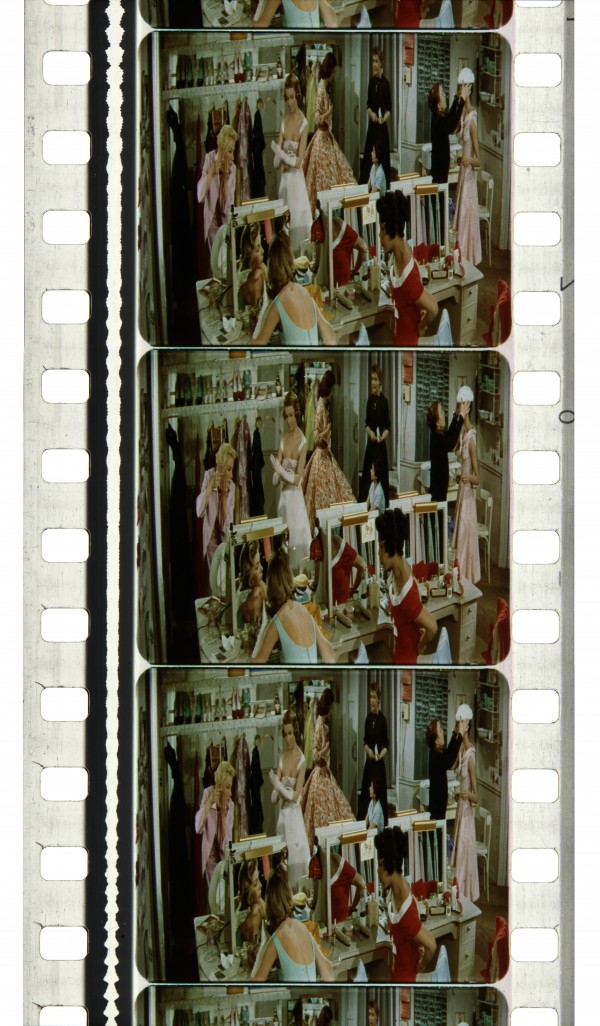
A 35mm original release print of Mannequins de Paris (1956), printed using Technicolor’s dye-transfer process. This was the first Franscope film to be released in France. The Franscope lens squeezed a wide 2.35:1 image onto a 35mm frame, which was unsqueezed again during projection.
Cinémathèque royale de Belgique – Cinematek, Brussels, Belgium.
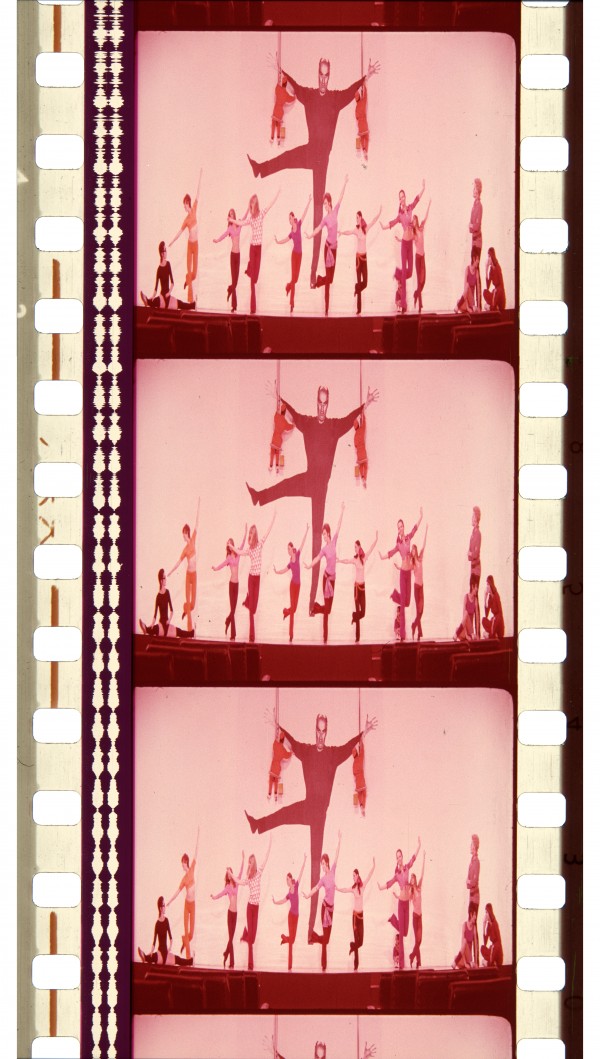
An original 35mm release print of L'Homme orchestre (1970) printed in Eastman Color, now faded. This was the last French film to be released in Franscope.
Cinémathèque royale de Belgique – Cinematek, Brussels, Belgium.
Identification
21.3mm x 18.15mm (0.838 in x 0.714 in).
B/W; various color processes (Gevacolor, Eastman Color, Ferraniacolor).
1
Original Franscope prints from the 1950s and 1960s now commonly suffer from color fading. Especially Eastman Color copies.
Franscope trademark featured on credits (with or without logo) and advertising.
Compatible with CinemaScope monophonic optical track.
22mm x 18.7mm (0.866 in x 0.736 in).
History
Franscope was the leading French anamorphic widescreen company of the 1950s and 1960s, with over 125 French films shot using its anamorphic lenses over a 15-year period. Jean-Placide Mauclaire’s company was the first in France to respond to 20th Century-Fox’s CinemaScope monopoly, offering a more economical and flexible alternative in 1953 with its Cinépanoramic process. Renamed Franscope in March 1956, the brand took market leadership in 1962, surpassing DyaliScope in domestic production, and remained dominant until 1970. Franscope answered complaints from producers and distributors who wanted to limit costs – its lenses were cheaper than CinemaScope’s – and to avoid modifying projectors and cinemas, thus escaping the CinemaScope monopoly. This success owed much to the trust French professionals placed in domestic trademarks (from 1957, domestic production no longer relied on American CinemaScope), but also to the marketing Mauclaire’s company carried out among cinematographers and directors through its corporate publication Le Film français. Indeed, Jean Dicop, an assistant cameraman, was inspired to develop the ingenious, higher-quality Franscope Suprématic system by the constraints operators faced when filming in anamorphic scope: reduced depth of field, the need for increased lighting, variation in the squeeze factor between the center of the frame and its edges, and parasitic reflections or flares. Following the DyaliScope monobloc lens, the Franscope “semi-block” system – a lens attachment – won over a growing number of operators.
In the 1950s, film production traditionally focused on the outdoors and the sensational, with historical adventure films shot in Eastmancolor (e.g., Bernard Borderie’s Tahiti ou la joie de vivre, 1956), or musical films (André Hunebelle’s Casino de Paris, 1957). From 1960 onwards, young auteurs began using Franscope – in particular the Zoom-Suprématic lens, which eliminated the need to change primary lenses – for their films: Lola (1960) by Jacques Demy, Une femme est une femme (1960) by Jean-Luc Godard, and Jules et Jim (1961) by François Truffaut. This opened French anamorphic scope production to low-budget productions, often shot in B/W: intimate dramas (Agnès Varda’s Les Créatures, 1965), psychological films (Luis Buñuel’s Journal d'une femme de chambre, 1963, or Godard’s Le Mépris, 1963), and popular crime films such as René Clément’s Les Félins (1963) and Compartiment tueurs (1964), directed by Costa-Gavras.
During the 1960s, films shot in Franscope achieved great public success: adventure films (100,000 dollars au soleil, Henri Verneuil, 1963), historical adventure films (Les Trois Mousquetaires, Bernard Borderie, 1961), espionage films (Banco à Bangkok pour O.S.S. 117, André Hunebelle, 1963), and comedies (Le Cerveau, Gérard Oury, 1968), notably those starring Louis de Funès. Franscope came to mark the golden age of French anamorphic scope filmmaking.
Although the last Franscope release came in 1970 and the company ceased operations the following year, the system was revived in the 1990s in France by another operator, Thierry Tronchet, and adapted to 16mm. This 16mm anamorphic “Tronchet scope” had a projected ratio of 2.74:1.
While modern anamorphic cameras are designed along the lines of the DyaliScope monobloc, there has been a recent trend among filmmakers and enthusiasts to reappropriate the retro aesthetics of 1950s and 1960s anamorphic images, reusing old anamorphic lenses (including Franscope) and adapting them to their digital cameras (particularly those with large sensors and 4:3 aspect ratios). (New Life Cine, 2021; True Lens Services, 2026).
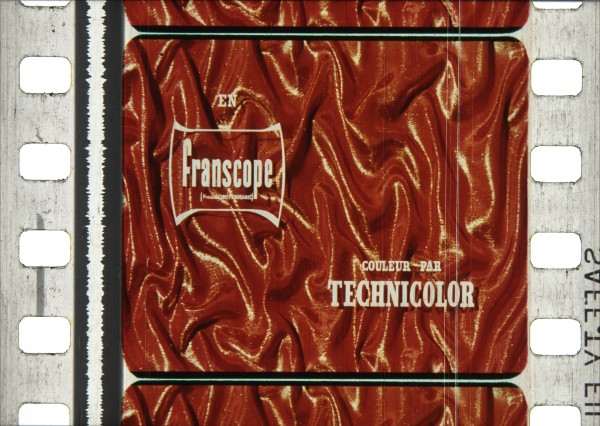
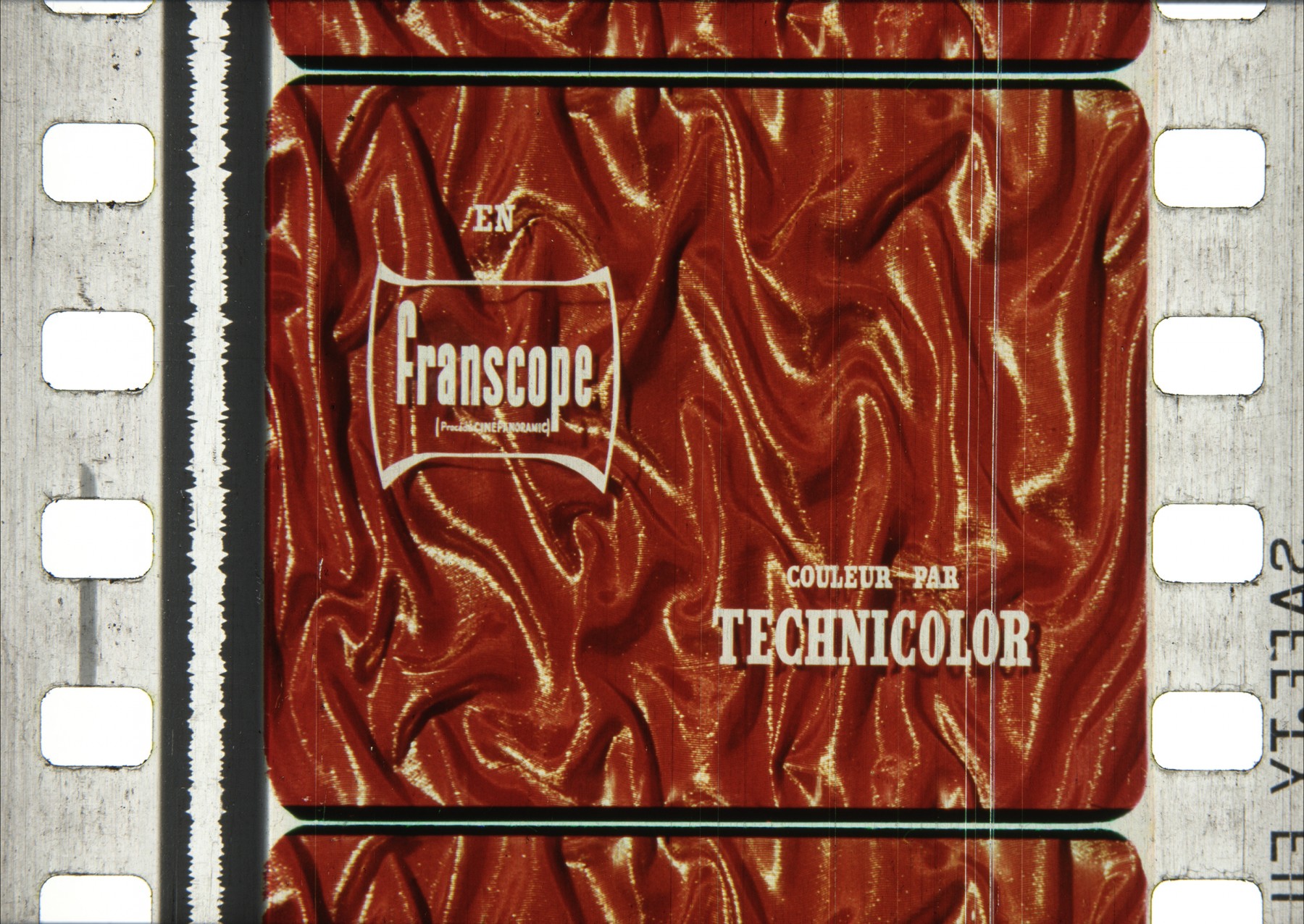
The Franscope and credit on a 35mm original release print of Mannequins de Paris (1956). The film was shot in Eastman Color negative and printed by Technicolor.
Cinémathèque royale de Belgique – Cinematek, Brussels, Belgium.
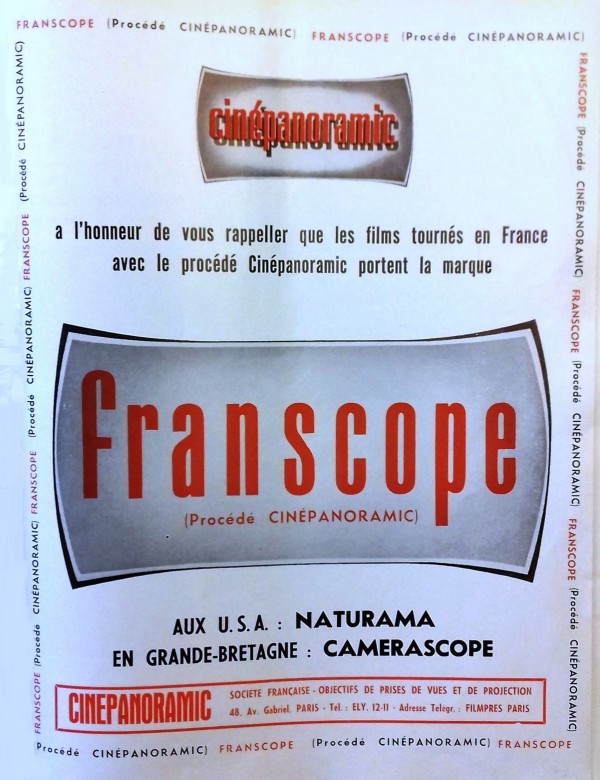
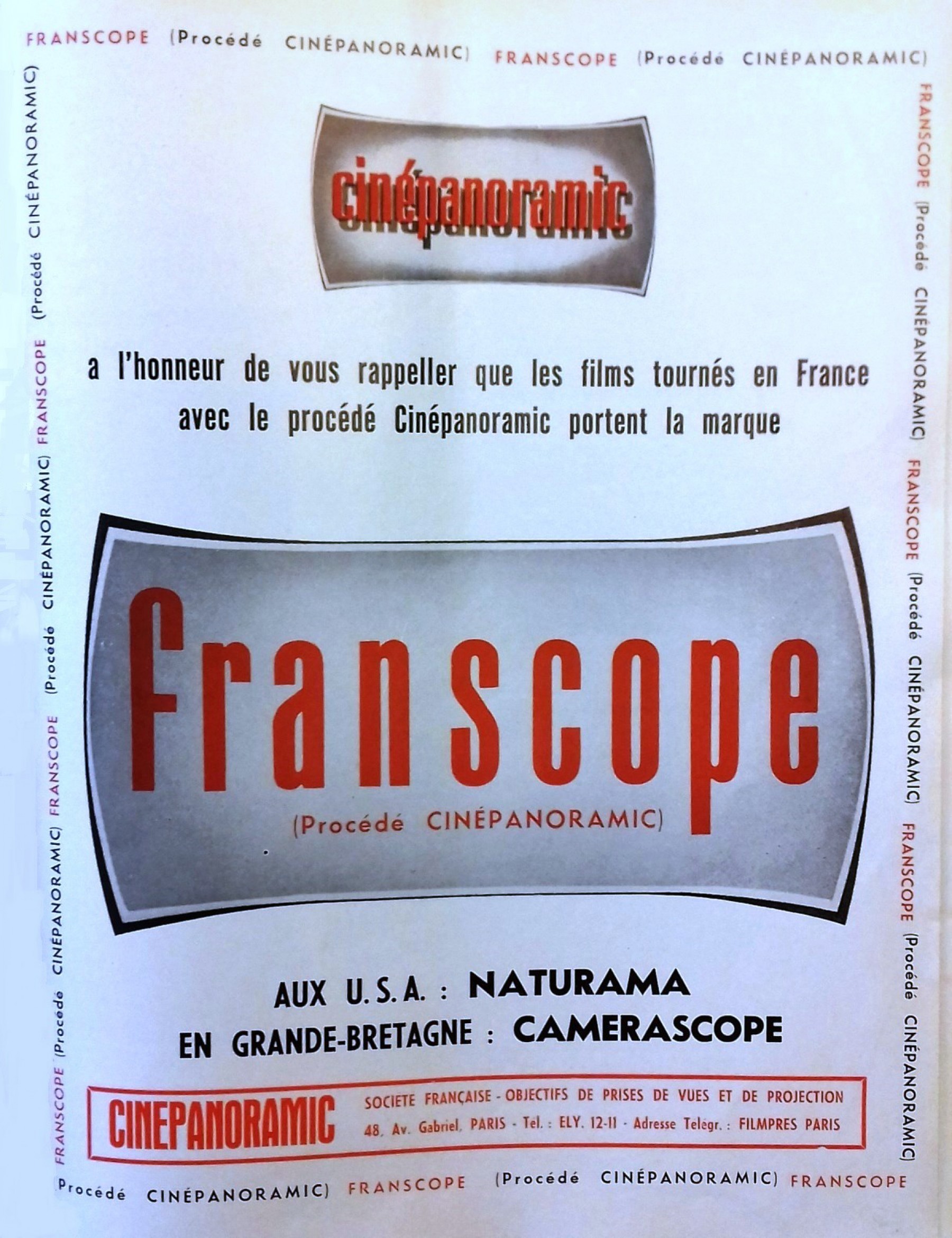
Cinépanoramic-DIC advertisement announcing the change of Cinépanoramic's trade name to Franscope.
Le Film français (1956), 651 (Nov. 2): p. 47.
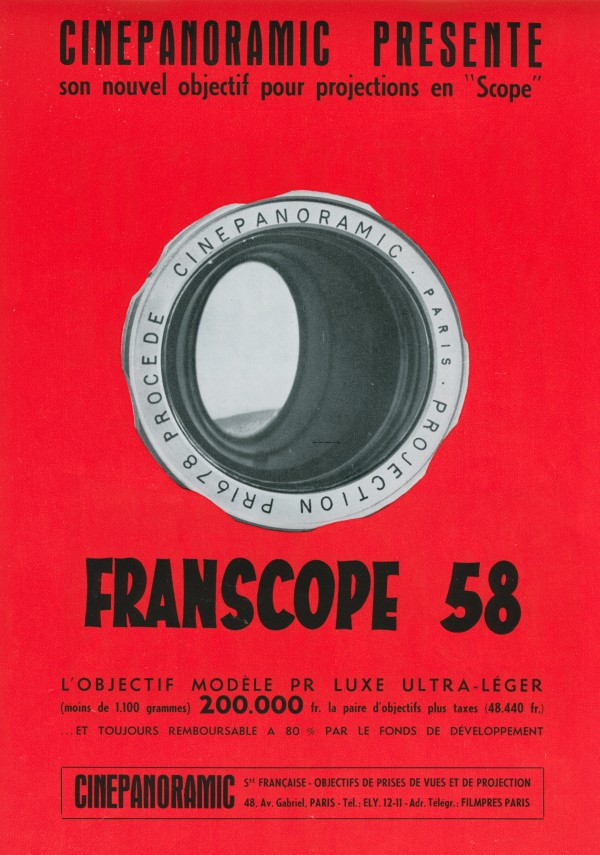
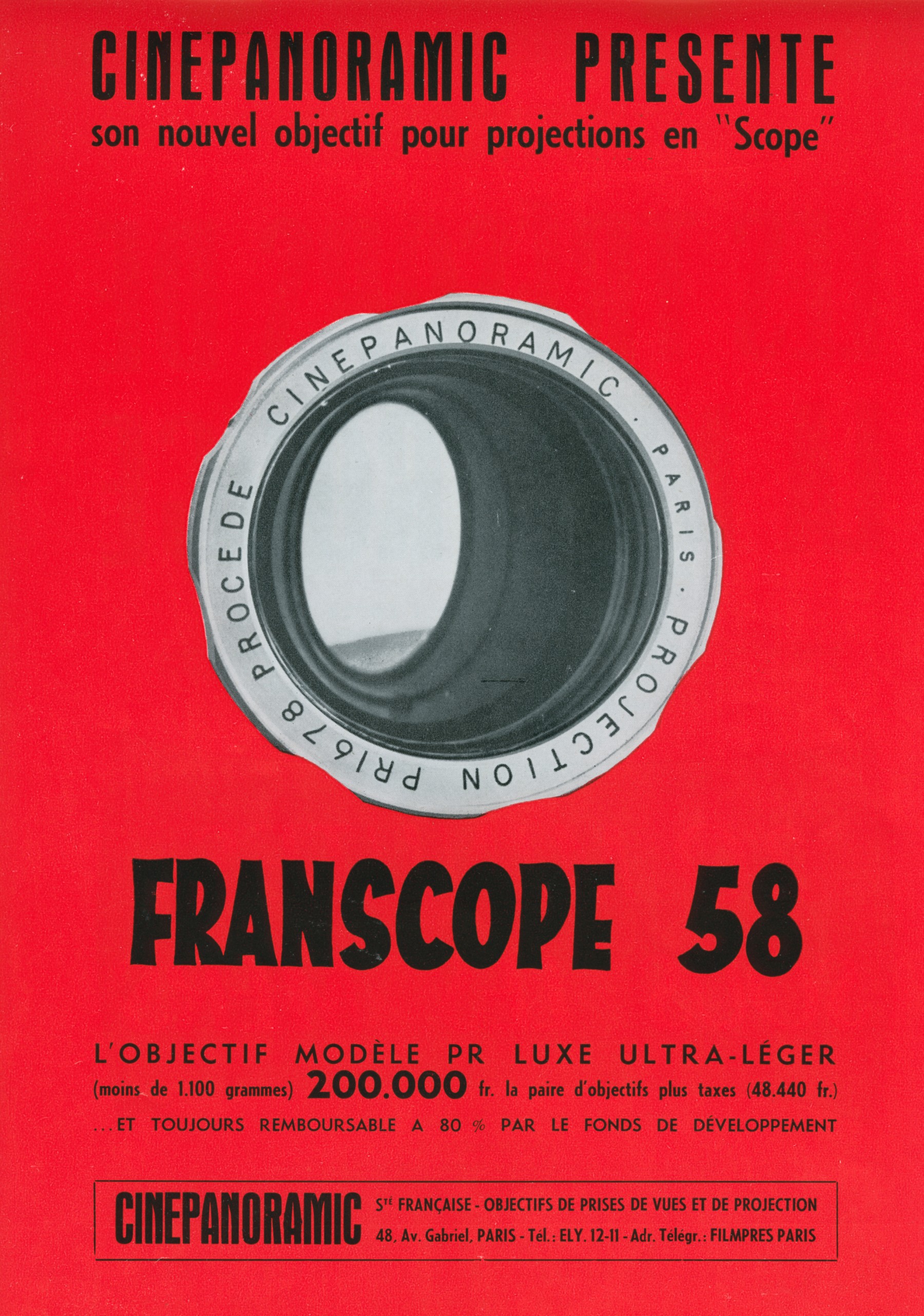
Cinépanoramic-DIC advertisement for the release of the “Franscope 58” projection anamorphic lens.
Le Film français (1958), 738 (Jul. 11): p. 16.
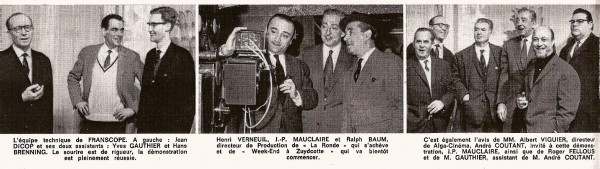
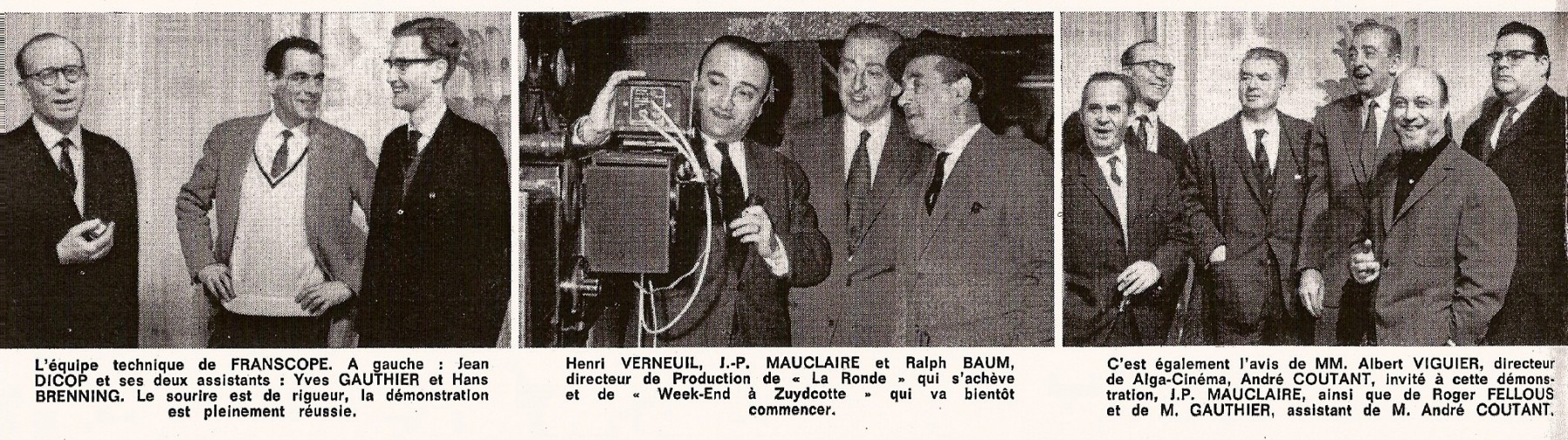
The Cinépanoramic-Franscope team and some of the company’s professional clients at the launch of the Franscope electronic viewfinder, March 1964.
Le Film français (1964), 1034 (Mar. 20): p. 4.
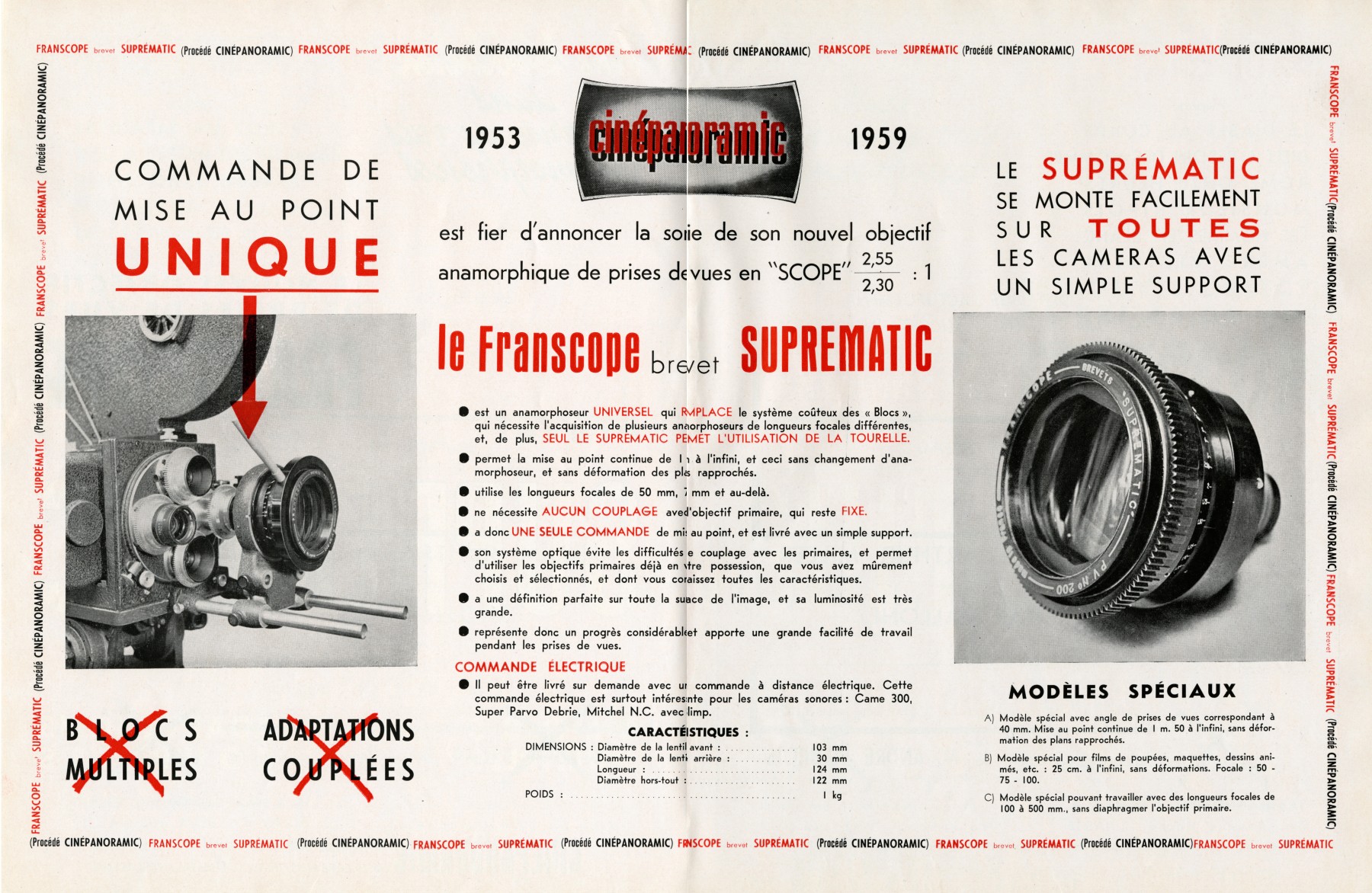
Cinépanoramic-DIC brochure advertising the “Franscope brevet Suprématic” anamorphic camera lens.
Le Film français (1959), 779–80 (Spring): pp. 3–4.
Selected Filmography
Shot by Ghislain Cloquet, this musical was filmed on location in Rochefort-sur-Mer. For its prestigious release, the 35mm Franscope Eastman Color negative was blown up to 70mm with 6-track magnetic stereo sound. It was released on March 8, 1967. One other film was shot in Franscope Eastman Color and blown up to 70mm – Henri Verneuil's La Bataille de San Sebastian, released on March 14, 1969.
Shot by Ghislain Cloquet, this musical was filmed on location in Rochefort-sur-Mer. For its prestigious release, the 35mm Franscope Eastman Color negative was blown up to 70mm with 6-track magnetic stereo sound. It was released on March 8, 1967. One other film was shot in Franscope Eastman Color and blown up to 70mm – Henri Verneuil's La Bataille de San Sebastian, released on March 14, 1969.
The opening credits include a humorous play on words, in reference to the format: stating that the film was shot by Raoul Coutard in “FRAN CHEMENT SCOPE” (which translates as “Very much scope”, or “Fran so (much) scope”) and Eastman Color; it was released on September 6, 1961.
The opening credits include a humorous play on words, in reference to the format: stating that the film was shot by Raoul Coutard in “FRAN CHEMENT SCOPE” (which translates as “Very much scope”, or “Fran so (much) scope”) and Eastman Color; it was released on September 6, 1961.
Starring Louis de Funès, this was the last domestic film released in Franscope (and Eastman Color), on September 18, 1970, followed by the disappearance of the trademark.
Starring Louis de Funès, this was the last domestic film released in Franscope (and Eastman Color), on September 18, 1970, followed by the disappearance of the trademark.
Shot in B/W Cinépanoramic at the end of 1955, the film was approved for release in May 1956, but was not released until a year later, on May 10, 1957, and thus bears the Franscope logo on its poster. The film is a sentimental comedy, shot by Michel Rocca, based on the novel L'Adorable Katherine by Jean des Vallières (published 1951), with Michel Auclair and Marie Daems.
Shot in B/W Cinépanoramic at the end of 1955, the film was approved for release in May 1956, but was not released until a year later, on May 10, 1957, and thus bears the Franscope logo on its poster. The film is a sentimental comedy, shot by Michel Rocca, based on the novel L'Adorable Katherine by Jean des Vallières (published 1951), with Michel Auclair and Marie Daems.
The first film by the young auteur, shot on location in Nantes in B/W Franscope by Raoul Coutard. Produced by Georges de Beauregard and Carlo Ponti, it was released on March 3, 1961. It was a hit, achieving a domestic audience of 616,114.
The first film by the young auteur, shot on location in Nantes in B/W Franscope by Raoul Coutard. Produced by Georges de Beauregard and Carlo Ponti, it was released on March 3, 1961. It was a hit, achieving a domestic audience of 616,114.
The first Franscope (and Eastman Color) film to be released in France, on September 19, 1956. Shot by Paul Cotteret, this comedy-drama set, in fashion circles, stars Madeleine Robinson, Ivan Desny and Mischa Auer.
The first Franscope (and Eastman Color) film to be released in France, on September 19, 1956. Shot by Paul Cotteret, this comedy-drama set, in fashion circles, stars Madeleine Robinson, Ivan Desny and Mischa Auer.
Technology
Unlike CinemaScope 2.55:1 and Cinépanoramic 2.55:1, Franscope was not a commercial “package” combining lenses, stereophonic sound and a reflective screen. Franscope used anamorphic lenses for shooting and projecting color or B/W films but was designed for 2.35:1 image projection with mono optical soundtracks. Initially under the trademark name “Cinépanoramic,” anamorphic lenses were introduced in the summer of 1954 to create images with a projected ratio of 2.30:1, probably to avoid charges of plagiarising CinemaScope’s 2.35:1. Originally designed as anamorphic lens attachments, they became coupled anamorphic lenses (one enclosed lens block) in November 1954.
It wasn’t until the summer of 1958 that a new concept in anamorphic lenses emerged, thanks to Jean Dicop (assistant operator from 1952 to 1956). This new system made the trademark a success in French cinema in the 1960s. An anamorphic system, called “semi-blocks” by Alain Gauthier, was developed under the trade name “Suprématic,” based on three patents filed by Dicop and the D.I.C. on August 5, 1958. It is difficult to know exactly which patent was used, but the system was based on an anamorphic lens – probably incorporating a third group of spherical lenses mounted in front of the two cylindrical groups – placed in front of the primary lens, with the two lenses centered and secured together with O-rings after the primary lens’s focus was locked at, or around, infinity. Focus was then set solely using the anamorphic lens. Designed by a practitioner rather than an engineer, this lens assembly used a single anamorphic lens that preserved the colorimetry (and defects) of the primary lenses paired with it, and let operators work with the primary lenses of their choice.
In 1961, the “Zoom-Suprématic” or “Zoomscope Franscope” was launched, a variable-focus anamorphic lens based on an Angenieux zoom (35–140mm) and equipped with a “gyroscopic focus variator” patented by operators Roger and Maurice Fellous. Among the first feature films shot with this lens are Lola (1961), Une femme est une femme (1961) and Tire-au-flanc 62 (1961).
The year 1964 marked the introduction of another innovation on French productions: the Franscope electronic viewfinder, consisting of a miniaturized electronic camera (“PYE 702”) attached to the Camé 300 Eclair camera, which displayed the exact frame of the filmed image on a miniature screen so that the cameraman no longer had to keep an eye pressed to the viewfinder’s magnifier eyepiece. The viewfinder could also be set up to display simultaneously on screens of various sizes for other technicians. It was first used on André Cayatte’s Piège pour Cendrillon (1965).
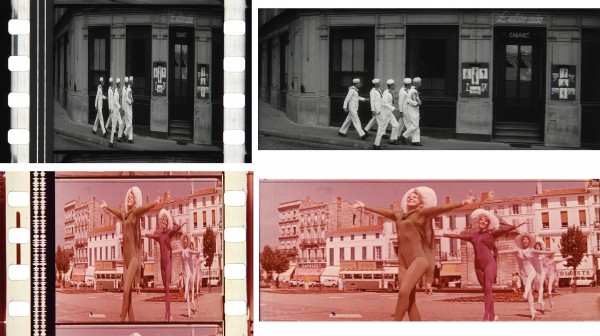
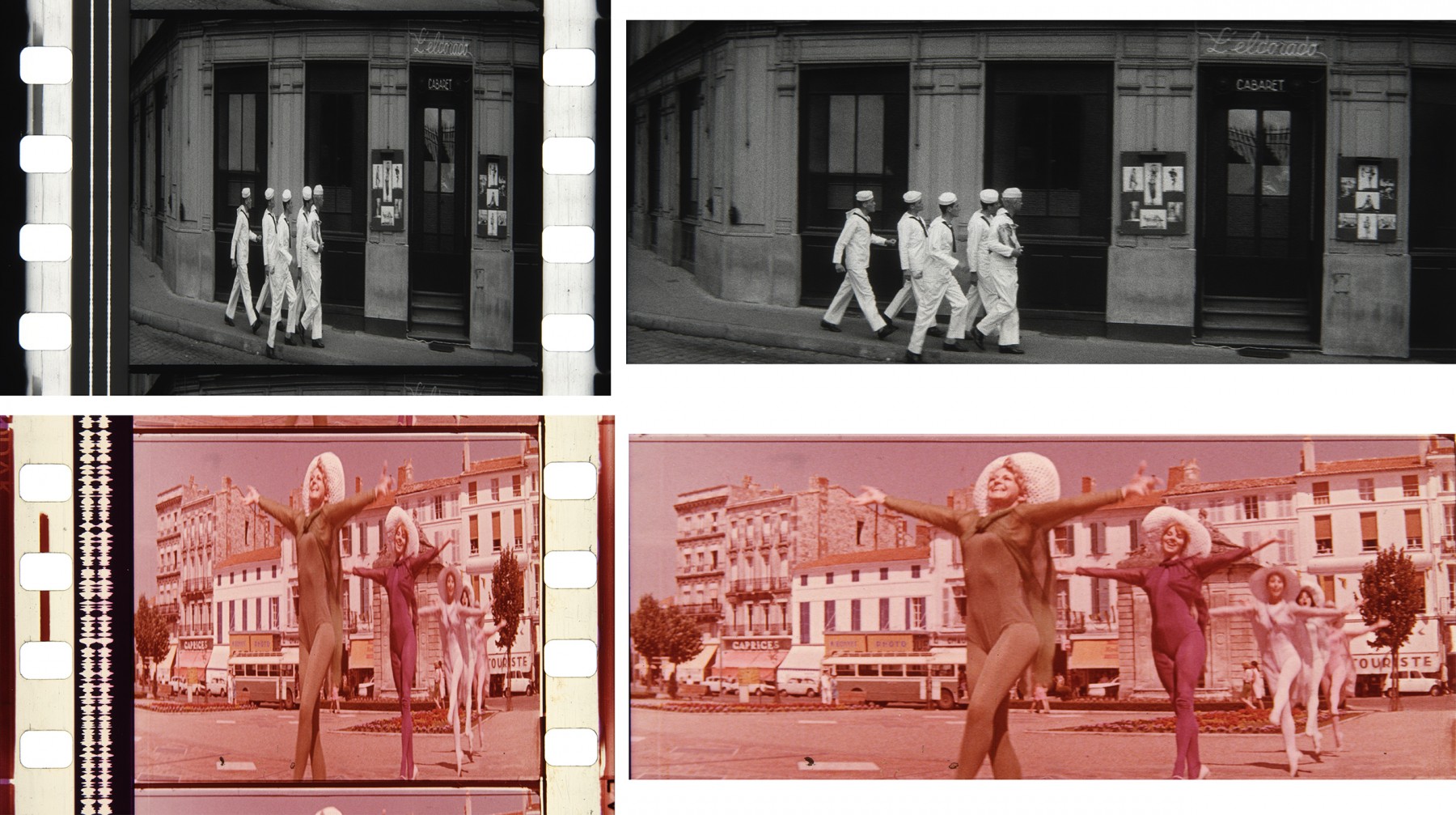
Original 35mm release prints of two Jacques Demy films: Lola (top, 1961) and Les Demoiselles de Rochefort (bottom, 1967). The 2.35:1 widescreen compositions are anamorphically squeezed into the narrower film frame during photography, and then unsqueezed again during projection.
Cinémathèque royale de Belgique – Cinematek, Brussels, Belgium. Diagram by Crystal Kui.
References
Anon. (1958). “Le nouvel objectif de prises de vues Franscope brevet Suprématic” [advertisement]. Le Film français, 738 (Jul. 11): pp. 13–15.
Anon. (1960). “Le Zoom-Suprématic” [advertisement]. Le Film français, 869–870: p. 44.
Anon. (1964). “La visée électronique à la prise de vues réduira le coût de la production” (“Electronic viewfinders during filming will reduce production costs” [advertisement]). Le Film français, 1034 (Mar. 20): p. 4.
Cinémathèque française & CNC (n.d.). “Franscope anamorphic lens”, inventory no. CNC-AP-16-1270. Catalogue des appareils cinématographiques de la Cinémathèque française et du CNC (website). https://www.cinematheque.fr/fr/catalogues/appareils/collection/objectif-anamorphoseur-de-prise-de-vuescnc-ap-16-1270.html (accessed July 23, 2026).
Cinémathèque française & CNC (n.d.). “Franscope Zoomscope Suprématic patent, anamorphic lens mounted on an Angénieux 35–140 mm zoom lens”, inventory nos. AP-98-2019 (1/2) and CNC-AP-15-1267 (1/2). Catalogue des appareils cinématographiques de la Cinémathèque française et du CNC (website).https://www.cinematheque.fr/fr/catalogues/appareils/collection/objectif-anamorphoseur-de-prise-de-vuesap-98-2019-1-2.html; https://www.cinematheque.fr/fr/catalogues/appareils/collection/objectif-anamorphoseur-de-prise-de-vuescnc-ap-15-1267-1-2.html (accessed July 23, 2026).
Festival du Film de Cannes (1956). “Cinépanoramic–Franscope” [advertisement]. Bulletin d’informations du Festival du Film de Cannes, no. 10 (May 2).
New Life Cine (2021). “Franscope Suprematic 35–140mm Anamorphic Zoom T4.4” [second-hand online marketplace]. newlifecine.com (website). https://newlifecine.com/product/franscope-suprematic-35-140mm-anamorphic-zoom-t4-4 (accessed July 23, 2026).
Reumont, François (1994). “Le système 16 scope de Thierry Tronchet”. Le Technicien du film, no. 431 (Jan. 15): p. 21.
Rousseau, Olivier (2007). “Les Formats larges dans le cinéma français de fiction (1953–2000) : histoire des techniques, production, exploitation, esthétique”, PhD diss., Université Paris 1 Panthéon-Sorbonne. https://theses.hal.science/tel-04184041.
Rousseau, Olivier (2014). “Histoire technique des formats larges en France (1953–1969) : stratégies nationales face à l’innovation américaine du CinémaScope”. FilmoScopeFR (website). https://www.academia.edu/9721471/_Histoire_technique_des_formats_larges_en_France_1953_1969_strat%C3%A9gies_nationales_face_%C3%A0_linnovation_am%C3%A9ricaine_du_Cin%C3%A9maScope (accessed July 23, 2026).
Rousseau, Olivier (2017). “CinemaScope, DyaliScope, Franscope: l’aventure du scope français dans les années 1950 et 1960”. Conference paper presented at La Cinémathèque française, Conservatoire des techniques cinématographiques. https://www.cinematheque.fr/video/1146.html.
True Lens Services (2026). “Case Studies: Cinematographer [DoP Chapin Hall] Provides Testimonial on TLS Franscopes”. www.truelens.co.uk (website). https://www.truelens.co.uk/cinematographer-provides-testimonial-on-tls-franscopes (accessed July 23, 2026).
Patents
Dicop, Jean, and Société D.I.C. “Anamorphoseur perfectionné.” French patent no. 1,204,784, filed August 5, 1958. Institut national de la propriété industrielle (INPI).
Dicop, Jean, and Société D.I.C. “Objectif anamorphoseur perfectionné.” French patent no. 1,204,785, filed August 5, 1958. Institut national de la propriété industrielle (INPI).
Dicop, Jean, and Société D.I.C. “Perfectionnements apportés aux anamorphoseurs.” French patent no. 1,204,786, filed August 5, 1958. Institut national de la propriété industrielle (INPI).
Distribution Internationale Cinématographique, S.A. “Franscope.” Trademark registration no. 456,908, filed March 29, 1956 (Paris). Bulletin officiel de la Propriété Industrielle, vol. 76 (1956): 1425, no. 71,673. Institut national de la propriété industrielle (INPI).
Preceded by
Compare
Related entries
Author
Olivier Rousseau holds a PhD from the Université Paris 1 Panthéon-Sorbonne, and wrote a thesis entitled Les Formats larges dans le cinéma français de fiction (1953-2000) : histoire des techniques, production, exploitation, esthétique, under the supervision of Jean A. Gili, defended in 2007. Senior teacher of modern literature, he has taught literature, expression-communication and cinema for over 20 years. He is currently editor-lexicographer at the Dictionary Department of the Académie française in Paris. He has published several articles on the history and aesthetics of wide formats in France (including “Le Format large en France (1953-2000): de la modernité à la cinématographicité de l’image”, Cahiers du CIRCAV, 2010; “Les procédés anamorphiques concurrents du CinémaScope (1953-1971), Le CinémaScope entre art et industrie, 2002) or on the peplum (“In CinemaScope. Péplum américain et format large : le spectacle total”, Positif, 2000). He has also taken part in several conferences (including ‘Le format large en France (1953-2009): statut singulier d’une innovation pérenne’, Impact Conference, Cinémathèque québécoise,Montréal, 2011; “Statistiques des genres des films larges en France (1953-2000). Spécificité française et interaction entre genre et valeurs de production”, Colloque IRCAV/Studies in French Cinema, Paris, 2010). He was also a lecturer at the Cinémathèque française as part of the Conservatoire des techniques cinématographiques in 2008 (“Technique et esthétique du CinemaScope”), and again in 2017 (“CinemaScope, DyaliScope, Franscope: l’aventure du scope français dans les années 1950 et 1960.” ). He is a member of the C.S.T. (Commission supérieure technique de l’image et du son). (https://independent.academia.edu/OlivierRousseau)
Roger and Maurice Fellous - cinematographers (in memoriam), Raoul Coutard - cinematographer (in memoriam), Alain Gauthier - former technical Director at Technovision France, Laurent Mannoni - Directeur scientifique du Patrimoine et directeur du Conservatoire des techniques, Cinémathèque française.
Rousseau, Olivier (2026). “Franscope”. In James Layton (ed.), Film Atlas. www.filmatlas.com. Brussels: International Federation of Film Archives / Rochester, NY: George Eastman Museum.
Margaux Chalançon